
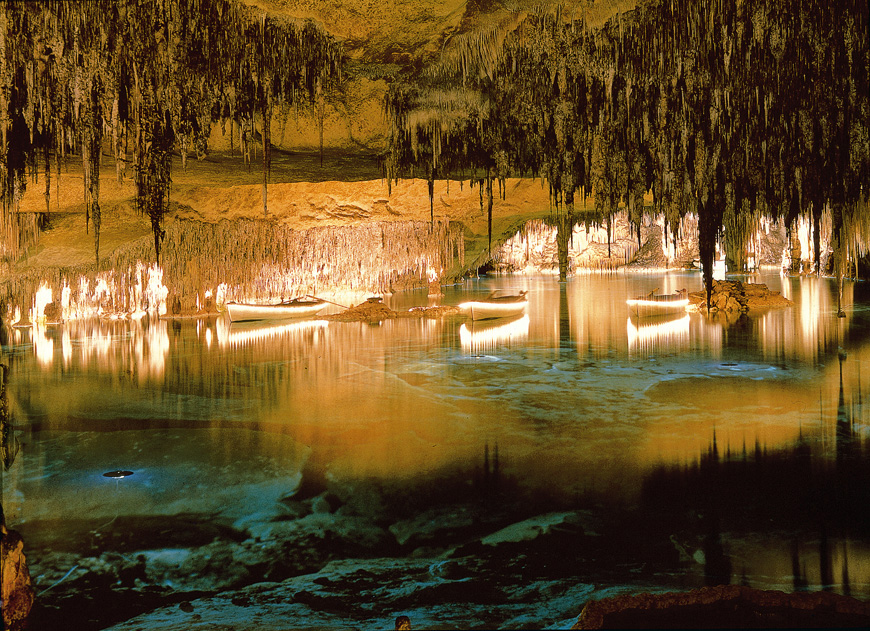
On the eastern coast of Mallorca, near the charming fishing village of Porto Cristo, lies one of Spain's most visited natural attractions. The Cuevas del Drach, or Dragon Caves, form a vast underground complex stretching over 1,200 metres in length and reaching 25 metres below the surface. At their heart lies Lake Martel, one of the largest underground lakes in the world, where visitors are treated to a unique classical music performance played from boats gliding across the still, turquoise waters.
History and Exploration
References to the Dragon Caves date back to the Middle Ages, when they appeared in manuscripts and local legends. The name "Drach" comes from the Catalan word for dragon, possibly inspired by the cave's deep, winding passages that early explorers imagined a dragon might inhabit. The caves were also mentioned by the French novelist Jules Verne, who drew inspiration from accounts of their underground waters.
Systematic exploration began in 1896 when French speleologist Edouard-Alfred Martel was commissioned by Archduke Ludwig Salvator of Austria to map the cave system. Martel discovered the vast underground lake that now bears his name and documented the extraordinary formations within. His work transformed the caves from a local curiosity into an internationally recognised natural wonder.
The Four Interconnected Caves
The Cuevas del Drach actually consist of four interconnected caves, each with its own distinctive character:
- Black Cave (Cova Negra) - The first cave discovered, notable for its dark basalt formations and narrow passages that set the tone for the journey ahead.
- White Cave (Cova Blanca) - Named for its pale calcite formations, this section features delicate curtain stalactites that resemble frozen waterfalls.
- Cave of Luis Salvador (Cova de Lluis Salvador) - Named after the Archduke who championed the caves' exploration, this section connects the older known chambers to Martel's discoveries.
- Cave of the French (Cova dels Francesos) - The largest and most spectacular chamber, home to Lake Martel and the cave's most impressive geological formations.
Lake Martel and the Concert Experience
Lake Martel stretches 177 metres in length and reaches depths of up to 12 metres. Its waters are a striking shade of turquoise, coloured by dissolved minerals and illuminated by carefully positioned lights that enhance the natural beauty of the space.
The highlight of every visit is the classical music concert performed on the lake. Musicians aboard small boats play pieces by composers such as Bach, Chopin, and Albinoni as they drift across the water. The cave's natural acoustics create a resonance that gives the music an almost otherworldly quality. After the performance, visitors have the option of crossing the lake by boat themselves, passing through the illuminated formations as they go.
This tradition of underground concerts dates back to the early 20th century and has become one of the most iconic visitor experiences in all of the Balearic Islands.
Visitor Information
Tips for Your Visit
The caves maintain a constant temperature of around 21 degrees Celsius with high humidity, making it comfortable in most clothing. However, the descent involves stairs, so comfortable footwear is recommended. Photography without flash is usually permitted, though the low light conditions make a camera with good low-light capability or a steady hand essential.
Porto Cristo itself is a pleasant base for exploring eastern Mallorca. The town has a selection of restaurants, a sandy beach, and a relaxed atmosphere that contrasts with the busier resorts further south. Visitors often combine a trip to the caves with a visit to the nearby Coves dels Hams, another cave system just a few minutes drive away.
Geological Significance
The cave formations at Drach are the result of millions of years of water dissolving limestone and redepositing calcium carbonate. The stalactites hanging from the ceiling and stalagmites rising from the floor create a landscape that shifts between the delicate and the monumental. Some columns, where stalactites and stalagmites have met, are estimated to be over a million years old. The presence of the Mediterranean Sea nearby has also influenced the cave's hydrology, with tidal movements still affecting the water level in Lake Martel.
For those interested in the science behind these formations, the Cave of Altamira article offers additional context on how Spain's cave systems have been shaped by geological and climatic forces over millennia.